A renewed threat to JPL as the Trump administration tries again to cut NASA

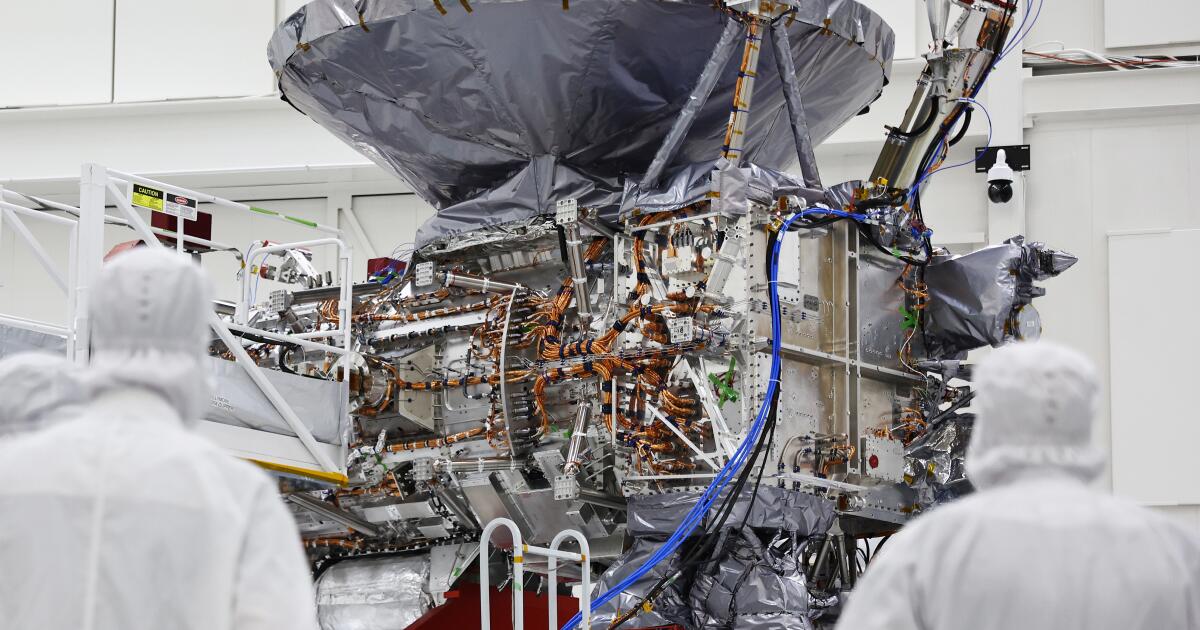
WASHINGTON — NASA also captured the world’s attention with Artemis II, which took astronauts to the moon and back for the first time in half a century. But the agency’s science projects could be in jeopardy again as the Trump administration mounts a new campaign to cut its funding dramatically — including for the Jet Propulsion Laboratory.
The cuts, proposed in the Trump administration’s 2027 budget request to Congress, would pose further challenges to the already weak Caltech-run lab and could seriously hurt America’s efforts to bring new discoveries back into space. They are consistent with last year’s administration’s effort to cut funding for NASA, which Congress ordered.
Although the Artemis project is billed as the cornerstone of NASA’s mission to Mars, exploring the Red Planet is among the efforts that could be cut short. The rover currently exploring the ancient river of Mars and the mission to orbit Venus are among the projects with JPL targeted for cost reduction, according to an analysis of NASA’s budget proposal by the non-profit organization Planetary Society.
“It’s not like that [because] they no longer produce good science. There’s no rhyme or reason to it,” said Casey Dreier, manager of space policy at the Planetary Society, which led opposition to a similar administration effort to cut NASA funding last year.
Storm clouds hang over the Jet Propulsion Laboratory on Feb. 7, 2024.
(David McNew/Getty Images)
In this case, the administration is asking Congress to cut NASA’s funding by 23% – including a 46% cut in its science programs, which are responsible for developing spacecraft, sending them into space to observe and analyze the data they bring back.
The proposal would cancel 53 science jobs and cut funding for others, according to an analysis by the Planetary Society. The effort to downsize NASA Science comes amid broader efforts by the Trump administration to cut scientific research across all government agencies.
The plan quickly drew bipartisan criticism from members of Congress, who rejected a similar administration proposal for 2026 in January. Republican Sen. Jerry Moran of Kansas, who chairs the Senate Appropriations subcommittee that oversees NASA, shown last week that he would work to fund NASA in the same way in 2027, saying it would be “a mistake” not to fund science.
Moran plans to hold talks with NASA administrator Jared Isaacman before the end of April to revise the budget request, a spokeswoman for his office said. The president’s budget request is a request to Congress, which holds the power to allocate funds.
But until Congress creates its own budget, NASA will use the plan as a road map, which could cut grants and contracts. The proposal “still creates chaos and great uncertainty right now about critical equipment, scientific personnel, and long-term research planning,” said Rep. Judy Chu (D-Monterey Park), whose district includes JPL.
A NASA spokesman declined to comment Friday. In the budget request, Isaacman wrote that NASA is “pursuing a focused and balanced portfolio” of its space science activities to match Trump’s cost-cutting goals.
The budget “reinforces US leadership in space science through emergency missions, completed research, and next-generation observatories,” Isaacman wrote.

Jared Isaacman testifies during his confirmation hearing for NASA administrator at the Russell Senate Office Building on Capitol Hill on Dec. 3, 2025.
(Anna Moneymaker / Getty Images)
At JPL — which for decades has led science and technology innovation at its La Cañada Flintridge campus — questions had already swirled about the lab’s role in the future of NASA’s mission.
More layoff rounds two years ago, i to reduce money of its resolution Mars Sample Return Mission and the Trump administration’s shift toward lunar exploration and away from the kind of scientific work that JPL is doing has pushed the lab into challenging territory.
There has been a steady stream of staff departures in recent months, and those who remain have been courting without funding from private investors, selling JPL technology to companies and ramping up production in hopes of keeping the lab running, according to two former employees, who asked not to be identified to describe the situation inside the lab.
“If we’re not doing science, what are we doing?” asked one former employee, who recently left JPL after more than a decade there.
A spokesman for the lab declined to comment, referring The Times to the budget proposal.
The NASA programs marked for cancellation or cuts support thousands of jobs at JPL and other facilities, said Chu, who led the increase in funding for NASA Science. After last year’s layoffs, JPL “cannot afford to lose this technology,” he said in a statement.
Among the JPL projects that appear slated for cancellation are two involving Venus, Dreier said. One, Veritas, is just starting to grow and will provide the lab with work for several years to come, he said.
The project will be the first US mission to Venus in more than 30 years, Dreier said, and aims to make a high-resolution map of the planet’s surface and observe its atmosphere.
The Perseverance rover, which is on Mars collecting rock and soil samples, may face cost cuts. The budget request proposes pulling some money from Perseverance to fund other planetary science missions and to slow down the rover’s “operating speed.”
While it is uncertain how Mars samples might return to Earth, the rover is still being used to explore the planet and look for evidence of whether it could be habitable.
Researchers hope that tubes of Martian rock, soil and soil can eventually be returned to Earth for study. The team has about half a dozen sample tubes to fill and the rover is in good shape, said Jim Bell, a planetary scientist and Arizona State University professor who leads the camera team on Perseverance, which works daily with JPL.
He said NASA’s spending proposal sets “no plan” for the future of the agency’s mission.
“Should people just get out of their comfort zone,” Bell asked, “and let these orbiters around other planets or rovers on other worlds – just die?”
The NASA document did not clearly indicate which programs were targeted for cuts and did not list which projects were targeted for cancellation. The Planetary Society and the American Astronomical Society each analyzed the proposal and found that dozens of projects appear to have been canceled without being named in the document.
Across NASA, other projects slated for cancellation by the Planetary Society include New Horizons, a spacecraft exploring the outer edge of the solar system; the Atmosphere Observing System, a planned project to collect weather, air quality and climate data; and Juno, a spacecraft studying Jupiter.
The administration’s plan also doesn’t prioritize new science projects, Bell said, which also threatens the long-term stability of jobs and space acquisitions at facilities like JPL.
“We’re going through this long period now where we have very few opportunities to build these spacecraft,” Bell said. “All NASA facilities suffer from a lack of opportunities.”
Last year, the Trump administration proposed cutting NASA’s 2026 funding by nearly half. Instead, Congress approved funding in January that gave the agency $24.4 billion — a roughly 29% cut from the proposed 46%. The 2027 budget request asks for $18.8 billion.
Congress has kept funding for scientific equipment almost stable, it was $7.25 billion for scientific expeditions, about a 1% decline from 2025. The administration had proposed cutting science investments to $3.91 billion. This time, the budget is asking for $3.89 billion.
Under the Trump administration, NASA has emphasized lunar exploration, including the successful Artemis II lunar mission. Isaacman, who defended the proposed cuts on CNN last week, it announced the organization’s monthly plans, including construction work base on the moon.
The agency has shown commitment to other existing science missions, including the James Webb Space Telescope, the upcoming Nancy Grace Roman Space Telescope, the Dragonfly spacecraft that will launch to Saturn’s moon in 2028, and other projects.
“NASA doesn’t have a big problem, we just need to focus on making and delivering world-changing results,” Isaacman told CNN.
Scientists have urged the government not to choose between funding science and research but to continue investing in both.
“In the end it’s kind of confusing, especially after the Artemis II mission,” said Roohi Dalal, associate director of public policy at the American Astronomical Society. “The scientific community … provides essential services to ensure that astronauts are able to carry out their mission safely, but at the same time, they are facing this major disruption.”