Survivors of the deadly force in Kuwait dispute the Pentagon’s account, saying the unit was “unprepared” to defend itself.

Survivors of the most dangerous Iranian attack in the US forces since the start of the war have disputed the Pentagon’s explanation of the events and said that their unit in Kuwait was left unaware of the accident in which six service members. they were killed more than 20 were injured.
Speaking publicly for the first time, members of the targeted unit gave CBS News a detailed account of the attack and its devastating aftermath from the perspective of those on the ground.
Members of CBS News spoke to dispute the description of events from Defense Secretary Pete Hegseth, who described the drone as a “squirter” — that it flew around protecting a stronghold inside Kuwait.
“Painting a ‘man drowned’ picture is false,” one of the wounded soldiers told CBS News. “I want people to know this unit … was not prepared to be accountable. It was not a strong position.”
This service member, like others who spoke on the condition of anonymity due to strict media restrictions in the military, said that despite the massacre, those inside the burned and isolated area responded quickly, with intelligence and heroism that saved lives.
“I don’t think the security environment or any leadership decision in any way diminishes their sacrifice or their mission,” a member of the Army’s 103rd Sustainment Command said in an interview. “Those soldiers put themselves in harm’s way and … I’m very proud of them, and their family should be proud of them.”
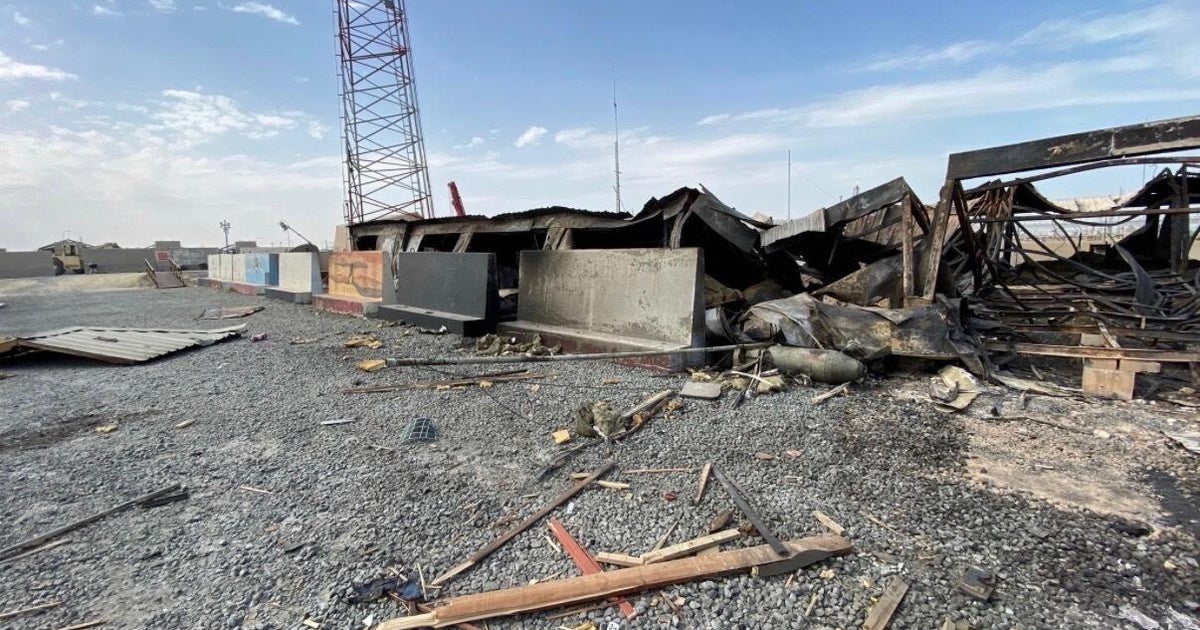
These first-hand eyewitness accounts, along with photos and videos of the attack’s aftermath obtained exclusively by CBS News, provide the first descriptions of what happened on March 1 slightly reinforced The location of the port of Kuwait on the day of the Iranian drone strike.
In the hours before the attack, missile alarms signaled a group of about 60 soldiers to take cover in a cement basement when a missile flew by. But around 9:15 in the morning, a very clear warning sounded. The officers took off their helmets and returned to their desks in the wood and tile workshop, about the width of three trailers.
From there they also began to control the movement of equipment, weapons and personnel throughout the Middle East.
About 30 minutes later, “everything shook,” one soldier told CBS News. “And it’s like what you see in the movies. Your ears are ringing. Everything is blurry. Your vision is blurry. You’re dizzy. There’s smoke everywhere.”
Dejected, the service member examined the painful scene: “Head wounds, heavy bleeding, many eardrums with holes, and there are blisters everywhere, so people are bleeding from their stomachs, bandages on their arms, bandages on their legs.”
Video showing smoke from the building, flames. The blast killed six – the deadliest attack on US troops since 2021 – and wounded more than 20 others.
It was epic.
“Get down to X”
About one week before the launch of Operation Epic Fury, many American soldiers and the Kuwaiti air force were moved to positions in Jordan and Saudi Arabia and away from the range of Iran’s missiles. Some soldiers said the leadership advised them that they would not last long – they would pack for 30 days and leave behind personal belongings, including their military-issued computers. Goal: don’t be a target.
“The way it was defined was ‘Get out of X,'” meaning away from the danger zone, one soldier who recently returned from deployment explained.
But for several members of the Army’s 103rd Sustainment Command at the large US base south of Kuwait City, there was a different set of orders: pack up everything and move to the Port of Shuaiba, a small military base on Kuwait’s southern coast.
The intelligence operations center resembled buildings typical of the wars in Iraq and Afghanistan – before the outbreak of the drone war. Steel-reinforced concrete barriers known as T-walls surrounded the building. These types of barriers are designed to protect service members from mortar or rocket fire but do not provide protection from air attack.
“It’s just kind of an old military base,” one soldier recalled. “Other small barriers. There are a lot of tin buildings where we can set up temporary offices.”
From there, the logistics staff will manage the flow and information of weapons, equipment and personnel throughout the Middle East theater. Still, the military told CBS News, they have questions about why it sits so comfortably within the range of Iran’s missiles and drones. Another soldier said they saw an intelligence unit showing the position on the list Iranian target.
“We came close to Iran, in an unsafe area that was known to be a target,” the soldier said. “I don’t think there was a good reason that was ever given.”
He said they were protected by a thin vertical vertical layer barriers burst that did not provide cover from above.
“From a bunker perspective, that’s about as weak as a person gets,” he said.
Asked to describe the level of reinforcement, he replied: “I mean, I would put it in the non-existent category. From the ability to protect the drone … there is none.”
A Pentagon spokesman declined to comment on the military’s allegations, citing an ongoing investigation into the attack on the Port of Shuaiba.
In a post on X talking before CBS news coverage about this incident, Assistant Secretary of Defense Sean Parnell said that “every measure has been taken to protect our soldiers – at all levels” and that “[t]the fortified area was surrounded by 6-foot walls.”
“It was chaos”
As the war progressed, it became clear that Iran would be moving away from conventional defenses and relying more on cheap and plentiful drones — an arsenal that has changed the balance of warfare in places like Ukraine.
It was one of those Iranian Shahed planes that exploded right into the heart of a US military base.
“It was chaos,” explained another wounded soldier. “Not one patient line should have been activated. You’re either on one side of the fire or on the other side of the fire.”
The soldiers, according to witnesses, tested themselves with makeshift bandages, restraints and tourniquets. They ordered private vehicles to drive the injured to two Kuwaiti hospitals in Kuwait City’s Fahaheel area.
“One of the most difficult things for me is that I know that we didn’t get everyone out, so I know that there are still soldiers inside who have not been identified and taken out,” said one survivor during the tense moment on the way to the hospital before other teams took out the rest.
“Telling the truth is important”
The words of Hegseth’s description of events at a press conference in Washington did not sit well with some survivors. The secretary described the drone as a “squirter” that “happened to hit a heavily fortified operational facility, but these are powerful weapons.”
And although several of those familiar with world events disagreed with the explanation, they did not want their comments to be misunderstood.
“It’s not my intention to demoralize or discredit the military or the Department of Defense as a whole, but I think telling the truth is important and we won’t learn from these mistakes if we pretend these mistakes never happened,” said one soldier.
When asked if this attack is true for a person to participate in the war, he agreed.
“That’s true,” he said.
Asked if the attack could have been avoided, the soldier added: “In my opinion, yes, yes.”
“I am very saddened by their loss and it is something I will carry with me for the rest of my life,” he said. “But I’m also very proud of them and their sacrifice, and their family should be too.”